Sunday, June 17, 2012


Thursday, June 14, 2012
a victory over the darkest corporation on the planet
Five Million Brazilian Farmers Take on Monsanto and Win $2 Billion
 14th June 2012
Five million Brazilian farmers have taken on US based biotech company Monsanto through
a lawsuit demanding return of about 6.2 billion euros taken as
royalties from them. The farmers are claiming that the powerful company
has unfairly extracted these royalties from poor farmers because they
were using seeds produced from crops grown from Monsanto’s genetically
engineered seeds, reports Merco Press.
In
April this year, a judge in the southern Brazilian state of Rio Grande
do Sul, ruled in favor of the farmers and ordered Monsanto to return
royalties paid since 2004 or a minimum of $2 billion. The ruling said
that the business practices of seed multinational Monsanto violate the
rules of the Brazilian Cultivars Act (No. 9.456/97). Monsanto has appealed against the order and a federal court ruling on the case is now expected by 2014.
About
85% of Brazil’s massive soyabean crop output is produced from
genetically engineered seeds. Brazil exports about $24.1 billion worth
of soyabeans annually, more than a quarter of its total agri-exports.
Farmers say that they are using seeds produced many generations after the initial crops from the genetically modified Monsanto seeds
were grown. Farmers claim that Monsanto unfairly collects exorbitant
profits every year worldwide on royalties from “renewal” seed harvests.
Renewal crops are those that have been planted using seed from the
previous year’s harvest. Monsanto disagrees, demanding royalties from
any crop generation produced from its genetically-engineered seed.
Because the engineered seed is patented, Monsanto not only charges an
initial royalty on the sale of the crop produced, but a continuing two
per cent royalty on every subsequent crop, even if the farmer is using a
later generation of seed.
The first
transgenic soy seeds were illegally smuggled into Brazil from
neighboring Argentina in 1998 and their use was banned and subject to
prosecution until the last decade, according to the state-owned
Brazilian Enterprise for Agricultural Research (EMBRAPA).The ban has
since been lifted and now 85 percent of the country’s soybean crop (25
million hectares or 62 million acres) is genetically modified, Alexandre
Cattelan, an EMBRAPA researcher told Merco Press. Brazil is the world’s
second largest producer and exporter of soyabean. China is one of its
biggest buyers.
“Monsanto
gets paid when it sell the seeds. The law gives producers the right to
multiply the seeds they buy and nowhere in the world is there a
requirement to pay (again). Producers are in effect paying a private tax
on production,” Jane Berwanger, lawyer for the farmers told the media
agencies.
and so it begins....
A Small Town REVOLUTION! Filettino (Italy) Declares Independence By Printing Its Own Banknotes

The
man who would be king? Mayor Luca Sellari displays Filettino's own bank
currency, the "Fiorito," which features his face, at his office in the
town.
A small town in central Italy has declared its independence and started to print its own banknotes.
The authorities in Filettino, 100km (70 miles) east of Rome, are protesting against austerity measures.
It
has only 550 inhabitants and under new rules aimed at cutting local
administration costs it will be forced to merge with neighbouring Trevi.
Town mayor Luca Sellari, who stands to lose his job because of the eurozone crisis, came up with the idea.
He
created his own currency, called the Fiorito. Banknotes have his head
on the back, and they are already being used in local shops and being
bought as souvenirs by tourists who have started to throng the normally
quiet streets.
The mayor says there is enormous enthusiasm about declaring the independence of the new principality.
There
has been such an outcry by small towns across Italy at the government
move to abolish local councils and merge them with larger towns that
Prime Minister Silvio Berlusconi’s coalition may be forced to backtrack.
In
the meantime the new Principality of Filettino – complete with coat of
arms and website – is suddenly enjoying international fame.
TV stations from as far afield as Russia have been running news features about Filettino.
After
all, the mayor says, Italy was once made up of dozens of principalities
and dukedoms. As he says, the landlocked republic of San Marino still
manages to survive, so why not Filettino?
Monday, June 11, 2012
questions

These questions have no right or wrong answers.
Because sometimes asking the right questions is the answer.
1. How old would you be if you didn’t know how old you are?
2.
Which is worse, failing or never trying?
3. If life is so short, why do we do so many things we don’t like and like so many things we don’t do?
4. When it’s all said and done, will you have said more than you’ve done?
5. What is the one thing you would most like to change about the world?
6. If happiness was the national currency, what kind of work would make you rich?
7. Are you doing what you believe in, or are you settling for what you are doing?
8. If the average human life span was 40 years, how would you live your life differently?
9. To what degree have you actually controlled the course your life has taken?
10. Are you more worried about doing things right, or doing the right things?
11.
You are having lunch with three people you respect and admire. They all
start criticizing a close friend of yours, not knowing she is your
friend. The criticism is distasteful and unjustified. What do you do?
12. If you could offer a newborn child only one piece of advice, what would it be?
13. Would you break the law to save a loved one?
14. Have you ever seen insanity where you later saw creativity?
15. What is something you know you do differently than most people?
16. How come the things that make you happy don’t make everyone happy?
17. What is one thing have you not done that you really want to do? What’s holding you back?
18. Are you holding onto something you need to let go of?
19. If you had to move to a state or country besides the one you currently live in, where would you move and why?
20. Do you push the elevator button more than once? Do you really believe it makes the elevator faster?
21. Would you rather be a worried genius or a joyful simpleton?
22. Why are you, you?
23. Have you been the kind of friend you want as a friend?
24. Which is worse, when a good friend moves away, or losing touch with a good friend who lives right near you?
25. What are you most grateful for?
26. Would you rather lose all of your old memories, or never be able to make new ones?
27. Is is possible to know the truth without challenging it first?
28. Has your greatest fear ever come true?
29. Do you remember that time 5 years ago when you were extremely upset? Does it really matter now?
30. What is your happiest childhood memory? What makes it so special?
31. At what time in your recent past have you felt most passionate and alive?
32. If not now, then when?
33. If you haven’t achieved it yet, what do you have to lose?
34. Have you ever been with someone, said nothing, and walked away feeling like you just had the best conversation ever?
35. Why do religions that support love cause so many wars?
36. Is it possible to know, without a doubt, what is good and what is evil?
37. If you just won a million dollars, would you quit your job?
38. Would you rather have less work to do, or more work you actually enjoy doing?
39. Do you feel like you’ve lived this day a hundred times before?
40. When was the last time you marched into the dark with only the soft glow of an idea you strongly believed in?
41. If you knew that everyone you know was going to die tomorrow, who would you visit today?
42. Would you be willing to reduce your life expectancy by 10 years to become extremely attractive or famous?
43. What is the difference between being alive and truly living?
44. When is it time to stop calculating risk and rewards, and just go ahead and do what you know is right?
45. If we learn from our mistakes, why are we always so afraid to make a mistake?
46. What would you do differently if you knew nobody would judge you?
47. When was the last time you noticed the sound of your own breathing?
48. What do you love? Have any of your recent actions openly expressed this love?
49. In 5 years from now, will you remember what you did yesterday? What about the day before that? Or the day before that?
50.
Decisions are being made right now. The question is: Are you making
them for yourself, or are you letting others make them for you?
Source - marcandangel.com
Wednesday, June 6, 2012
david vs goliath
Monsanto Blocked – Mexican Farmers Halt Law to Privatize Plants and Seeds
 5th June 2012
By Occupy Monsanto
Progressive
small farmer organizations in Mexico scored a victory over
transnational corporations that seek to monopolize seed and food
patents. When the corporations pushed their bill to modify the Federal
Law on Plant Varieties through the Committee on Agriculture and
Livestock of the Mexican Chamber of Deputies on March 14, organizations
of farmers from across the country sounded the alarm. By organizing
quickly, they joined together to pressure legislators and achieved an
agreement with the legislative committee to remove the bill from the
floor.
What’s at stake is free
and open access to plant biodiversity in agriculture. The proposed
modifications promote a privatizing model that uses patents and “Plant
Breeders’ Rights” (PBR) to deprive farmers of the labor of centuries in
developing seed. The small farmers who worked to create this foundation
of modern agriculture never charged royalties for its use.
Although
the current law, in effect since 1996, pays little heed to the rights
of small farmers, the new law would be far worse. Present law tends to
benefit private-sector plant breeders, allowing monopolies to obtain
exclusive profits from the sale of seeds and other plant material for up
to 15 years, or 18 in the case of perennial ornamental, forest, or
orchard plants–even when the plants they used to develop the new
varieties are in the public domain.
The
legislative reform would extend exclusive rights from the sale of
reproductive material to 25 years. Further, it seeks to restrict the
rights of farmers to store or use for their own consumption any part of
the harvest obtained from seeds or breeding material purchased from
holders of PBRs.
The proposed law would also include genetically modified organisms (GMOs) among the plant varieties covered, converging with the so-called Monsanto
Law (Law of Biosecurity and Genetically Modified Organisms). This is an
absurd inclusion, since GMOs are created by introducing genetic
material from non-plant species.
GMOs
cannot be considered a distinct variety, because they do not result
from the genetic variability that underlies natural selection. They are
the result of manipulation through biotechnology that crosses the
boundaries between species and realms. Another absurdity is the private
appropriation of genetic information from live organisms, even those
altered with genes of other species.
The
proposed law would create a “Monsanto Police,” by giving the National
Service for the Inspection and Certification of Seeds the authority to
order and conduct inspection visits, demand information, investigate
suspected administrative infractions, order and carry out measures to
prevent or stop violations of PBR, and impose administrative sanctions,
which are increased by the proposal. It would have a government agency
promote PBRs held by individuals or corporations.
Holders
of PBRs already gain exclusive rights to exploit plant varieties and
material for their propagation. The bill under consideration would
extend those rights over the products resulting from use of monopolized
plant varieties so that, for example, a special license would have to be
obtained to use the variety in foods for human consumption or
industrial uses.
Farmers Win a Battle, but the Offensive Continues
Now
that the regular session has been concluded and the bill wasn’t
presented, it will have to wait for a new session. Withdrawal of the
bill was a victory for the social organizations over the transnational
beneficiaries of the bill, particularly Monsanto.
The
battle was won, but the bill is still pending as Monsanto and other
large corporations wait for a better time. With Mexican elections just
months away, they’re waiting for a time when the political cost of these
measures that harm producers’ rights won’t have immediate electoral
repercussions.
As now formulated, the
reform would further strengthen the legal underpinnings for pillage
that the Mexican Congress has been shaping since the North American Free
Trade Agreement (NAFTA) began to be negotiated and then went into
effect. The proposed reforms derive directly from the intellectual
property agreements contained in annex 1701.3 of NAFTA.
In
2005, the Monsanto Law opened the door for cultivating genetically
modified seed in Mexico. The seed is the property of the same
transnational corporations that produce the agricultural chemicals used
on the GMOs, to their own benefit and the detriment of the food supply,
health, and economic well being of the Mexican people.
When
the reforms went through the Senate and Chamber committee, members of
the Mexican Congress–with the exception of members of the Party of the
Democratic Revolution–tossed caution aside and disregarded the warnings
of scientists not paid by the transnationals. They decided to forget
that small farmers and native peoples, with their ancestral practices of
cultivation, selection, and free interchange of seeds, are the ones who
created existing plant varieties and are the real owners of the
agro-genetic wealth of the country.
Organizations
of small farmers declared their opposition because the proposed reforms
would deepen the crisis of Mexican agriculture and increase poverty and
food dependency, both of which have increased alarmingly under the
present administration.
The
organizations presented a document to the leaders of all factions in the
Chamber of Deputies requesting them to send the proposed law back to
Committee. They demanded that the legislature open up a discussion on
the inadvisability of continuing to privatize the means of production of
foodstuffs, given the Mexican government’s obligation to uphold the
right to food.
The right to food was
only recently approved as a constitutional reform in Mexico. The United
Nations Special Rapporteur for the Right to Food, Olivier De Schutter,
anticipated the debate by stressing the need to strengthen the legal
framework to oppose the reform on Plant Varieties already approved by
Congressional Committee.
In the final
report of his visit to Mexico, submitted a few weeks ago, the UN
official said that Mexico should approve a law establishing a framework
for the right to food, declare a moratorium on planting genetically
modified corn, and adopt measures against the monopolization of the
production of seeds.
In addition,
farmers argue that the nation needs community seed banks and
decentralized, participatory programs to conserve agricultural
biodiversity. The organizations are preparing to extend the debate and
launch legal action against the bill, such as filing injunctions and
claims of unconstitutionality, since Article 27 of the Mexican
Constitution protects the genetic diversity of species as part of the
national patrimony.
Source - occupymonsanto360.org
Monday, June 4, 2012
The Disappearance of the Universe
i recently underwent yet another 'dark night of the soul' and found myself questioning all i had learned on the spiritual path. everywhere i looked it seemed as if the spiritual community/world had become just another sales pitch, information to be marketed. It seemed that all healing, however miraculous, was still temporary. the world around me, especially the spiritual world, with it chakras and kundalini and trance channels, was becoming one more shadow, one more illusion within an illusion.
i asked for guidance and this book, "The Disappearance of the Universe" was delivered to me. i read it. i didn't like it. i didn't like its message, even though it was validating my own feelings, that everything -- including the spiritual universe -- is still a dream. i wasn't fond of the author's voice. i was concerned about the christian terminology. but i couldn't stop reading.
and it changed everything.
and i am discovering a deeper peace than ever before.
the book is re-dissussion -- a clarification -- of "The Course In Miracles", which i had started to read years ago and didn't understand. now i do. i had thought it yet another philosophy of love and non-attachment (it is that).
what i now realize is that it is also and ultimately a highly technical manual on how to wake up from the dream-within-the-dream.
though, like me, you may have questions about certain christian terminology (brings up bad memories), it is not a christian book. it embraces buddhism -- to a point. it is not New Age. it is not anti- any religion. it is anti-time, space, form and energy; all that holds the illusion together and keeps us separate from our True Home.
it is the message that Jesus ("J", "the Voice") tried to convey 2,000 years ago to an audience that couldn't comprehend time and space and multi-dimensionality; the quantum nature of the physical and energetic universe. the mind and ego.
here are some quotes from the book; decide for yourself.
http://www.youtube.com/watch?v=EOfa-u9EAOQ
i asked for guidance and this book, "The Disappearance of the Universe" was delivered to me. i read it. i didn't like it. i didn't like its message, even though it was validating my own feelings, that everything -- including the spiritual universe -- is still a dream. i wasn't fond of the author's voice. i was concerned about the christian terminology. but i couldn't stop reading.
and it changed everything.
and i am discovering a deeper peace than ever before.
the book is re-dissussion -- a clarification -- of "The Course In Miracles", which i had started to read years ago and didn't understand. now i do. i had thought it yet another philosophy of love and non-attachment (it is that).
what i now realize is that it is also and ultimately a highly technical manual on how to wake up from the dream-within-the-dream.
though, like me, you may have questions about certain christian terminology (brings up bad memories), it is not a christian book. it embraces buddhism -- to a point. it is not New Age. it is not anti- any religion. it is anti-time, space, form and energy; all that holds the illusion together and keeps us separate from our True Home.
it is the message that Jesus ("J", "the Voice") tried to convey 2,000 years ago to an audience that couldn't comprehend time and space and multi-dimensionality; the quantum nature of the physical and energetic universe. the mind and ego.
here are some quotes from the book; decide for yourself.
http://www.youtube.com/watch?v=EOfa-u9EAOQ
Sunday, June 3, 2012
How to Grow The Top 10 Most Nutritious Vegetables in Your Garden

By Colleen Vanderlinden
Treehugger
A
perfectly ripe, juicy tomato, still warm from the sun. Sweet carrots,
pulled from the garden minutes (or even seconds!) before they’re eaten.
Growing your own vegetables is one of those activities that balances
practicality and indulgence. In addition to the convenience of having
the fixings for a salad or light supper right outside your door (or on
your windowsill), when you grow your own vegetables, you’re getting the
most nutritional bang for your buck as well. Vegetables start losing
nutrients as soon as they’re harvested, and quality diminishes as sugars
are turned into starches. For the tastiest veggies with the best
nutrition, try growing a few of these nutrient-dense foods in your own
garden.
And don’t let the lack of a yard stop you – all of them can be grown in containers as well.
Broccoli
is high in calcium, iron, and magnesium, as well as Vitamin A, B6, and
C. In fact, one cup of raw broccoli florets provides 130% of your daily
Vitamin C requirement.
- How to Grow Broccoli
- Grow Broccoli in Containers: One broccoli plant per pot, pots should be 12 to 16 inches deep.
- What to Watch Out For: Cabbage worm. If you start seeing pretty white butterflies fluttering around your broccoli, you’re guaranteed to start seeing little green worms all over your broccoli plants. To avoid this, cover your broccoli plants with floating row cover or lightweight bed sheets. If you start seeing cabbage worms, simply pick them off by hand.
There
is nothing like peas grown right in your own garden – the tender
sweetness of a snap pea just plucked from the vine is unlike anything
you can buy in at a store. Aside from being absolutely delicious, peas
are high in fiber, iron, magnesium, potassium, and Vitamin A, B6, and C.
- How to Grow Peas
- Grow Peas in Containers: Sow peas approximately 2 inches apart in a pot that is at least 10 inches deep. Provide support for peas to climb up.
- What to Watch Out For: Hot weather. Once the weather turns hot, pea production will pretty much shut down. Grow peas in early spring and late summer/autumn, or any time of year when temperatures are consistently between 40 and 85 degrees Fahrenheit.
While
snap beans (green beans/wax beans) are a great addition to any garden,
it’s the beans we grow as dried beans that are real nutritional
powerhouses. Dry beans, in general, are high in iron, fiber, manganese,
and phosphorous.
- How to Grow Beans
- Grow Beans in Containers: Bush beans are your best option for growing in containers. Plant beans four inches apart in a container that is at least 12 inches deep.
- What to Watch Out For: Harvest at the right time. Harvest dry beans when the pods have completely dried on the vine. The pods should be light brown, and you should be able to feel the hard beans inside. Shell the beans, and let them sit out a few days to ensure that they’re completely dry before storing them in jars in a cool, dark, dry place.
4. Brussels Sprouts
The
bane of many a childhood, Brussels sprouts get a bad wrap mostly due to
overcooking. When prepared right, Brussels sprouts are sweet, tender,
and delicious. They also provide tons of fiber, magnesium, potassium,
and riboflavin, as well as high levels of Vitamins A, B6, and C.
- How to Grow Brussels Sprouts
- Grow Brussels Sprouts in Containers: Grow one plant per 16-inch deep container.
- What to Watch Out For: Cabbage worms (see “Broccoli, above.)
5. Tomatoes
Fresh,
homegrown tomatoes are the reason many gardeners get into vegetable
gardening in the first place. There’s just nothing that compares to
eating a perfectly ripe tomato, still warm from the sun. Tomatoes are
also incredibly good for us, packing plenty of fiber, iron, magnesium,
niacin, potassium, and Vitamin A, B6, and C. They’re also a great source
of the antioxidant lycopene.
- How to Grow Tomatoes
- Grow Tomatoes in Containers: Container sizes will vary depending on the variety you’re growing. If you’re growing an indeterminate variety, your container will need to be at least 18 inches deep. For determinate varieties, 12 inches is a good depth, and for dwarf or “patio” type tomatoes, 8 inches is perfect. One tomato plant per pot.
- What to Watch Out For: Tomato horn worm can be a problem in many areas – these large caterpillars should be removed by hand whenever you see them. Also watch out for signs of blight, which is a real problem in many parts of the U.S.
6. Red Bell Peppers
Red
bell peppers are high in potassium, riboflavin, and Vitamins A, B6, and
C – in fact, one cup of red bell pepper packs an amazing 317% of the
recommended daily allowance of Vitamin C and 93% of the recommended
Vitamin A.
- How to Grow Peppers
- Grow Peppers in Containers: Plant one pepper plant per each 8 to 12 inch deep pot.
- What to Watch Out For: Aphids and flea beetles are the two most common insect pests when growing peppers. While both can be controlled with insecticidal soap, which is a common organic option, you can also make all-natural, homemade sprays to deter these pests. A tomato leaf spray will get rid of aphids, and garlic/hot pepper spray works very well on a flea beetle infestation.
7. Beets
Beets
are a great “two-fer” crop – you can harvest the beet roots, of course,
but you can also harvest and eat the greens. Young beet greens are
delicious when added raw to a salad, and larger beet greens can be
sauteed as a quick side dish or used the way you’d use other greens such
as spinach. Beet roots are very high in iron, potassium, and vitamin C.
Beet greens are even better, as they are high in iron, calcium,
magnesium, potassium, zinc, and Vitamins A, B6, and C.
- How to Grow Beets
- Grow Beets in Containers: Plant beet seeds three inches apart in a container that is twelve inches deep. Because each beet seed is actually a cluster of seeds, be sure to thin the seedlings to one per cluster. Thinnings can be added to salads or sandwiches.
- What to Watch Out For: Knowing when to harvest. Beet roots are at their best when they are harvested small – between one and two inches across. At this size, they are sweet and tender. Larger beets tend to be kind of woody and less flavorful.
Leaf
amaranth is a less-common vegetable that is well worth a try in your
own garden. The leaves have a sweet and slightly tangy flavor that works
well in a variety of dishes, from stir-fries and soups to simply
steaming it all by itself. As a bonus, leaf amaranth is one of the few
heat-tolerant greens. It won’t bolt in the heat of summer the way
spinach and kale are prone to. Nutritionally, leaf amaranth is very high
in calcium, iron, magnesium, phosphorous, potassium, riboflavin, zinc,
and Vitamins A, B6, and C. Everyone should be growing this!
- How to Grow Leaf Amaranth
- Growing Leaf Amaranth in Containers: Scatter the tiny seeds over the soil’s surface in a pot that is at least 8 inches deep. Harvest the leaves when they are two to four inches tall. You will be able to get at least two or three harvest before you’ll have to sow more seeds.
- What to Watch Out For: Leaf amaranth is fairly easy to grow, and relatively problem-free. Rarely, leaf miners can become a problem.
9. Carrots
Carrots
are at their sweetest, crunchiest best when freshly harvested from the
garden. These icons of healthy eating deserve their “good-for-you” rep –
they’re very high in fiber, manganese, niacin, potassium, and Vitamins
A, B6, and C. Their only drawback is that they do tend to be high in
sugar, so if you’re watching your carb intake, you’ll want to limit the
amount of carrots you eat.
- How to Grow Carrots
- Grow Carrots in Containers: Sow carrot seeds two to three inches apart in a pot that is at least twelve inches deep. Look for shorter varieties, such as ‘Thumbelina,’ or ‘Danver’s Half Long.’
- What to Watch Out For: Harvesting at the perfect size. Carrots are at their tastiest when harvested small. Leaving them in the ground too long can result in overly large, woody carrots. You’ll also want to make sure to keep your carrots evenly moist, as letting the soil dry out too often can also result in somewhat bitter, fibrous carrots.
10. Leafy Greens
OK,
I cheated here. I can’t recommend just ONE leafy green, because they
are all incredibly good for us, as well as delicious — kale, collards,
spinach, turnip or dandelion greens — how can you possibly choose just
one? In general, the “green leafies” contain high amounts of calcium,
iron, potassium, and Vitamins A, B6, and C.
- How to Grow Kale and Other Leafy Greens
- Grow Greens in Containers: Grow one kale or collard plant per ten inch deep pot. Other greens can be grown a few plants to a pot — they should be planted at least 4 inches apart and harvested small.
- What to Watch Out For: Heat and cabbage worms. Most leafy greens are cool-weather crops, so they’re best grown in spring and fall in most areas – hot weather will cause them to bolt. In addition, many of these greens are members of the Brassicas family, which means they are prone to cabbage worm infestations. Control them with the same methods outlined in the “Broccoli” section, above.
Try
growing one or two (or all!) of these nutrient-dense, delicious
vegetables in your own garden, and you’ll get double the health
benefits: healthy food and time spent outdoors, nurturing your plants.
Thursday, May 31, 2012
treating cuts and wounds

Although cuts and wounds aren’t particularly threatening in nature, they can be quite painful as well as a nuisance.
However,
infections could result from cuts, so many individuals turn to some
kind of pharmaceutical solution to clean the laceration because that is
truly the only solution they know of. Along with nearly all other
issues, though, cleaning and hastening the healing process of a cut or
wound can be done with numerous natural solutions – not the all too common Neosporin.
Being recognized as one of nature’s mighty superfoods, honey has long been utilized for its antibacterial properties. One study published in the journal Microbiology found that honey prevented a type of streptococcus pyogenes from inhibiting the healing of wounds.
Researchers conducting the lab tests found that even the smallest amount of honey was enough to kill off the majority of bacterial cells on the skin which infects the wound site. Honey could even be utilized to prevent wounds in the first place.
Not
only is the information presented by the study proof of honey’s healing
power, but people have literally been benefiting from the topical use of honey
over the course of history. You could also place a band aid over the
thin layer of honey on the wound, and apply a thin layer of organic cold
pressed coconut oil to further prevent infection.
Another widely used solution for cuts is the topical appliance of cayenne powder.
Cayenne can be used to not only heal wounds, but to help stop any
bleeding as well. In fact, many people attest to its ability to halt
bleeding nearly instantly. Simply pour some cayenne powder on the wound
(however much is needed depending on size) and wrap the wound site with a
bandage. You may leave it on throughout the day or overnight, and
re-apply how many times is needed. Of course you could combine other
natural solutions with the cayenne to clean the cut, such as honey, or apple cider vinegar. As an alternative to stop the bleeding, black pepper has been shown to be effective while also harnessing analgesic, antibacterial, and antiseptic properties.
About the Author
Anthony
Gucciardi is an accomplished investigative journalist with a passion
for natural health. Anthony’s articles have been featured on top
alternative news websites such as Infowars, NaturalNews, Rense, and many
others. Anthony is the co-founder of Natural Society,
a website dedicated to sharing life-saving natural health techniques.
Stay in touch with Natural Society via the following sites Facebook – Twitter – Web
build a solar stove
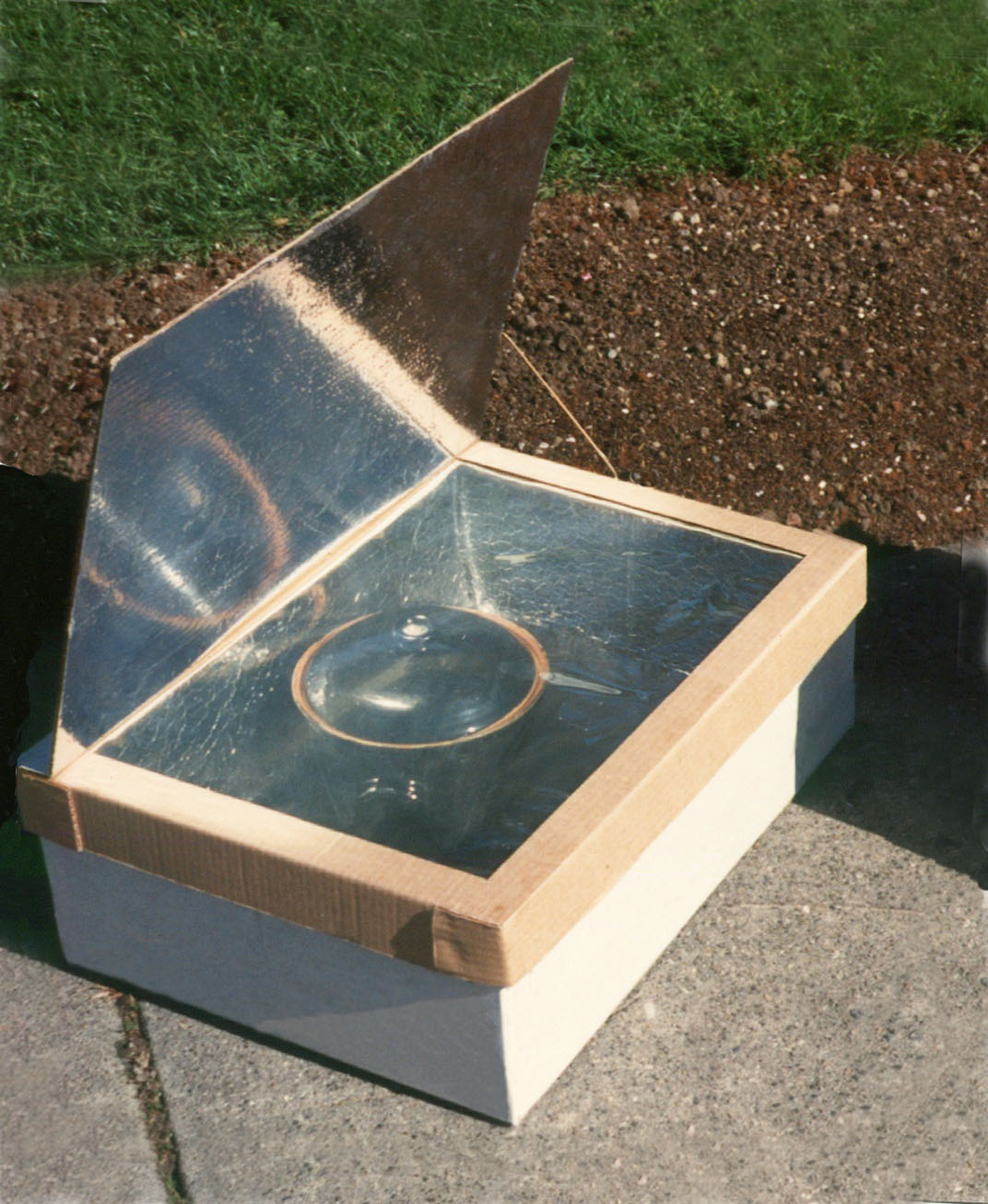
The “Minimum” Solar Box Cooker
is a simple box cooker that can be built in a few hours for very little
money. When this cooker was designed, it was named it the “Minimum
Solar Box Cooker” because, at the time, it represented the simplest
design we could devise. What we didn’t communicate with that name was
that this is a full-power cooker that works very well, and is in no way minimum as far as its cooking power goes.
What You Will Need
- Two cardboard
-
One sheet of cardboard to make the lid. This piece must be
approximately 2 to 3 inch (4 to 8 cm) larger all the way around than the
top of the finished cooker (the outer box).
- One small roll of aluminum foil
- One can of flat-black spray paint
- At least 8 ounces (250 g) of white glue
- One Reynolds Oven Cooking Bag®. These are available in almost all supermarkets in the U.S. and they can be mail-ordered from Solar Cookers International
Building the Base

Fold
the top flaps closed on the outer box and set the inner box on top and
trace a line around it onto the top of the outer box, Remove the inner
box and cut along this line to form a hole in the top of the outer box
(Figure 1).
Decide how deep you want
your oven to be. It should be about 1 inch (2.5 cm) deeper than your
largest pot and about 1″ shorter than the outer box so that there will
be a space between the bottoms of the boxes once the cooker is
assembled. Using a knife, slit the corners of the inner box down to that
height. Fold each side down forming extended flaps (Figure 2). Folding
is smoother if you first draw a firm line from the end of one cut to the
other where the folds are to go.

Glue
aluminum foil to the inside of both boxes and also to the inside of the
remaining top flaps of the outer box. Don’t bother being neat on the
outer box, since it will never be seen, nor will it experience any wear.
The inner box will be visible even after assembly, so if it matters to
you, you might want to take more time here. Glue the top flaps closed on
the outer box.

Place
some wads of crumpled newspaper into the outer box so that when you set
the inner box down inside the hole in the outer box, the flaps on the
inner box just touch the top of the outer box (Figure 3). Glue these
flaps onto the top of the outer box. Trim the excess flap length to be
even with the perimeter of the outer box.
Finally,
to make the drip pan, cut a piece of cardboard, the same size as the
bottom of the interior of the oven and apply foil to one side. Paint
this foiled side black and allow it to dry. Put this in the oven so that
it rests on the bottom of the inner box (black side up), and place your
pots on it when cooking. The base is now finished.
Building the Removable Lid

Take
the large sheet of cardboard and lay it on top of the base. Trace its
outline and then cut and fold down the edges to form a lip of about 3″
(7.5cm). Fold the corner flaps around and glue to the side lid flaps.
(Figure 4). Orient the corrugations so that they go from left to right
as you face the oven so that later the prop may be inserted into the
corrugations (Figure 6). One trick you can use to make the lid fit well
is to lay the pencil or pen against the side of the box when marking
(Figure 5). Don’t glue this lid to the box; you’ll need to remove it to
move pots in and out of the oven.

To
make the reflector flap, draw a line on the lid, forming a rectangle
the same size as the oven opening. Cut around three sides and fold the
resulting flap up forming the reflector (Figure 6). Foil this flap on
the inside.
To make a prop

Next,
turn the lid upside-down and glue the oven bag (or other glazing
material) in place. We have had great success using the turkey size oven
bag (19″ x 23 1/2″, 47.5cm x 58.5cm) applied as is, i.e., without
opening it up. This makes a double layer of plastic. The two layers tend
to separate from each other to form an airspace as the oven cooks. When
using this method, it is important to also glue the bag closed on its
open end. This stops water vapor from entering the bag and condensing.
Alternately you can cut any size oven bag open to form a flat sheet
large enough to cover the oven opening.
Improving Efficiency
The
oven you have built should cook fine during most of the solar season.
If you would like to improve the efficiency to be able to cook on more
marginal days, you can modify your oven in any or all of the following
ways:
- Make pieces of foiled cardboard the same size as the oven sides and place these in the wall spaces.
- Make a new reflector the size of the entire lid (see photo above).
- Make the drip pan using sheet metal, such as aluminum flashing. Paint this black and elevate this off the bottom of the oven slightly with small cardboard strips.
Cooking Directions
Put food in dark pots. Use with dark, tight-fitting lids.
Choose a cooking location.
Set the cooker on a dry, level surface in direct sunshine away from
potential shadows. For best results, solar cooking requires continuous,
direct sunshine throughout the cooking period.
Put the pots in the cooker and replace the lid.
Put the pots in cooker. If you’re cooking multiple dishes,
quicker-cooking items should be placed toward the front of the cooker
(opposite the reflector) and slower-cooking items toward the back, where
access to sunlight is best. Place the lid on cooker.
Orient the cooker.
Orient the cooker according to the details below. Once oriented, the
cooker doesn’t need to be moved again during three to four hours of
cooking. For longer cooking, or for large quantities of food,
reorienting the cooker every couple of hours speeds cooking a little.
Food cooks fastest when the shadow created by the cooker is directly
behind it.
To cook a noontime meal orient the cooker so that the front side (opposite the reflector) faces easterly, or approximately where the sun will be midmorning. In general, it is good to get the food in early and not worry about it until mealtime. For most dishes you should start cooking by 9 or 10 am.
To cook an evening meal orient the cooker so that the front side faces westerly, or approximately where the sun will be midafternoon. For most dishes, it’s best to start cooking by 1 or 2 pm.
For all-day cooking orient the cooker toward where sun will be at noon or early afternoon. The food will be ready and waiting for the evening meal.
To cook a noontime meal orient the cooker so that the front side (opposite the reflector) faces easterly, or approximately where the sun will be midmorning. In general, it is good to get the food in early and not worry about it until mealtime. For most dishes you should start cooking by 9 or 10 am.
To cook an evening meal orient the cooker so that the front side faces westerly, or approximately where the sun will be midafternoon. For most dishes, it’s best to start cooking by 1 or 2 pm.
For all-day cooking orient the cooker toward where sun will be at noon or early afternoon. The food will be ready and waiting for the evening meal.
Adjust the reflector. With the adjustable prop, angle the reflector so that maximum sunlight shines on the pots.
Leave the food to cook for several hours or until done. There is no need to stir the food while it is cooking.
Remove the pots.
Using pot holders, remove the pots from the cooker. (CAUTION: Pots get
very hot.) If you won’t be eating for a couple of hours, you may want to
leave the pots in the cooker and close the lid. The insulative
properties of the cooker will keep the food warm for a while.
Enjoy!
FAQ’s- 1 Troubleshooting
- 1.1 Why doesn’t my solar cooker work?
- 1.2
My cooker only gets up to 250°F (121°C). Is this hot enough to cook
when recipes call for 350°F (177°C) or even 450°F (232°C)?
- 1.3 Solar cooking usually takes longer than cooking on a conventional stove. Is there any way to speed it up?
- 1.4 What happens if clouds go in front of the sun while I’m cooking?
- 1.1 Why doesn’t my solar cooker work?
make your own bug spray

ORGANIC BUG SPRAY FROM ONION SCRAPS
You
can make your own organic bug spray from kitchen leftovers! Simply save
your onion skins, peels and ends then refrigerate in an empty
margarine-sized tub or ziplock bag until the container is full. Once you
have enough, place the onion pieces in a pail and fill with warm water.
Soak for a few days, up to a week. You can keep this on the patio in
the sun to steep but this is optional. After one week, strain the onion
bits out and store the onion water in spray bottles.
Bury
the onion bits around plants that are prone to aphids, spiders and
other pests. Just spray both house and garden plants with the water to
fight aphids and pests. You can also mix your garlic trimmings in with
the onion pieces, bugs hate garlic too!
CURE FOR WHITE/BLACK SPOT (mildew)Add *1 litre of FULL cream milk to an *8 litre watering can, watered on Roses or mildew attracting plants, will kill white/black spot
SCALES
Make the oil spray by blending two cups of vegetable oil with one cup of pure liquid soap, and mix it until it turns white.
Dilute
one tablespoon of the emulsion to one litre of water and spray all
affected areas thoroughly. Do this during mild weather, because if it’s
hot it may burn the plant’s leaves.
Scales
shoot a sweet substance called honeydew. Ants literally farm the scale
to feed on the honeydew. They’ll pick them up and they’ll move them all
over the tree. Honeydew also leads to sooty mould, a black dusty fungus
that grows over the leaves and stems. Controlling the scale will also
get rid of the sooty mould.
If you
only have a small amount of scale, scrape it off with a fingernail or
toothbrush. Larger infestations can be controlled by spraying with an
oil to suffocate them.
To
keep APHIDS and OTHER PESTS off your roses: Finely chop 1 onion and 2
medium cloves of garlic. Put ingredients into a blender with 2 cups of
water and blend on high. Strain out pulp. Pour liquid into spray bottle.
Spray a fine mist on rose bushes, making sure to coat both tops and
bottoms of leaves.
GARLIC SPRAY
Chop
90 grams of garlic, cover with mineral oil let soak over night, strain,
add 1 litre of soapy water and store in a glass jar with a sealed lid.
Dilute one part garlic to 50 parts water for use in spraying.
ALUMINUM FOIL “FOILS” APHIDS
Use an aluminum foil much around the base of plants such as tomatoes. The reflection confuses the insects and drives them away.
GENERAL PESTICIDE
3
hot green peppers (canned or fresh) 2 or 3 cloves garlic 3/4 tsp liquid
soap 3 cups water Puree the peppers and garlic cloves in a blender.
Pour into a spray bottle and add the liquid soap and water. Let stand 24
hours. Strain out pulp and spray onto infested plants, making sure to
coat both tops and bottoms of leaves.
AGAINST INSECT PESTS
1.
Soapy water (NOT detergent). Try to find one based on caustic potash,
rather than caustic soda and mix well with water until frothy (you’ll
need more soap in hard water areas). For aphids and other soft-shelled
insects
2. Oil
sprays suffocate insects. Boil 1 kg soap with 8L of oil, stirring until
dissolved. Dilute 1:20 with water just before use. Spray on cool days
only.
3. Tomato leaf spray (very poisonous). Cover leaves with water, boil and cool. Use immediately as a general insecticide.
4.
Pyrethrum spray. Pick almost-open flowers of Tanacetum cinerariifolium
and dry in a cool place. Cover a few tablespoons of flowers with cheap
sherry, steep overnight and mix with a litre of hot soapy water. Cool
and use within a few days as a general insecticide. Store in a dark
place.
5. Wormwood spray. Infuse leaves in boiling water and leave for a few hours. Dilute 1:4 and use for sap-sucking insects.
6.
Chilli spray – equal volumes chilli and water blended and sprayed fresh
onto caterpillars. (Prevent contact with eyes and skin.)
7. Lapsang Souchong tea – a strong brew (1 tbspn in a pot) deters possums from nipping rose tips
8.
Many other materials can be used to make insect sprays. Depending on
what you have available, try -quassia, garlic, marigolds, melaleuca,
parsnips, turnips, eucalyptus, larkspur, elder, white cedar (Melia
azaderach) or rhubarb (Please note: larkspur, elder (except for ripe
berries) white cedar and rhubarb leaves are all highly toxic to humans.)
AGAINST FUNGAL DISEASES
The
following plants reportedly contain antifungal or antibacterial
chemicals that you can extract via infusion to spray onto
crops:Chamomile, chives, sheoak (Allocasuarina), elder, eucalyptus,
garlic, horseradish, hyssop, melaleuca (tea-tree), neem (Azadirachta
indica), nettle (Urtica dioica), and thyme.
ANTI FUNGALS:
1. Milk spray: a 1:1 mix of milk and water reportedly controls black spot on roses and fungal diseases on other plants
2. Fresh urine (a healthy person’s urine is sterile)
3. Condy’s Crystals: 1gram/L of potassium permanganate. Use immediately.
4. Washing soda: 110g dissolved in 5.5L water. Add 56g soap and use immediately.
5.
Bordeaux mixture: In a bucket completely dissolve 90g of copper
sulphate in 6.5L water. In another bucket, thoroughly mix 125g brickies
lime with 2.5L water and strain into first bucket. Mix well and use
immediately. 6. Dusting sulphur
BORDEAUX MIXTURE
This
is a standard organic fungicide used to treat a wide range of rots,
mildews, and blights. Mix 90g of copper sulphate (bluestone) with 4.5
litres of hot water in a non metallic container and leave overnight.
Next day mix 125g slaked lime with 4.5 litres of cold water in a non
metallic container. Combine both mixtures by stirring vigorously. Use
immediately. An oil like Codacide can be added to increase its
effectiveness. Bordeaux spray may clog nozzles. Also, if over-used, it
may lead to a build up of copper in the soil and associated toxicity.
OTHER PEST CONTROL HINTS
1.
Use companion plants that mask the scent or appearance of desirable
crops. Many highly aromatic plants contain chemicals designed to make
them unattractive to pests. Camphor, mints, scented pelargoniums,
wormwood, southernwood, lavender, balm of Gilead, rosemary, sage and
many other herbs have spicy/bitter scents rather than sweet ones. When
actively growing amongst desirable crops, these herbs can confuse pest
insects by masking attractive scents.
2.
Use companion plants that act as trap, sacrifice or indicator crops.
Some plants, including nasturtium, mustard and Chinese cabbage, can be
used as decoys so that pests attack them rather than your crop. Roses
planted along the edges of vineyards deter human predators but also
provide early warning of mildew disease!3. Use Physical Pest ControlsThe
good ol’ “see ’em and squash ’em” technique still works a treat for
snails and slugs. Attract them with beer in a jar sunk into the ground,
or lay a wooden plank a centimetre above the ground – they’ll shelter
underneath it and you can squash them in the morning. Yellow boards
painted with sticky oil will attract aphids. Control ants to reduce
aphid and scale infestations on trees – a band of grease will stop them
climbing the trunk. Codling moth can also be reduced by banding trees
with corrugated cardboard soaked in derris spray.
ORGANIC
SPRAY. Quarter fill your spray bottle with vinegar, a teaspoon each of
molasses (melt down in a cup of hot water) and liquid soap, top up with
tap water.
BUG JUICE
Collect
by hand the nuisance pest, bug, grub or snail from your garden. Place
the bug(s) into a blender, cover with fresh water and switch on. DON’T
FORGET THE LID. Then strain, dilute 1 part to 20 parts of water into a
spray bottle. Spray the juice on the underside of the leaves as well as
on top.
MILK
Milk
is effective against a range of mildews on peas, pumpkins and cucumber
leaves. Use equal parts milk and water and spray every couple of days
until the mildew is under control. If the mildew is out of control
remove the affected leaves to avoid the mildew from spreading and do not
water at night, try watering in the mornings.
MOLASSES SPRAY
Molasses
is a good deterrent sticky spray, ideal for cabbage moths and grubs on
the Brassicas. Blend 1 tablespoon of molasses with 1 litre of hot water
until the colour of weak tea, then mix in one tea spoon of detergent,
which will help the molasses to stick to the leaves, spray top and under
side of the leaves. You could also add vinegar to this brew to make it
more potent.
VINEGAR SPRAY
For
cabbage moths and grubs on the Brassicas. Blend 1/4 vinegar with 3/4 of
water, then mix in one tea spoon of detergent, which will help the
vinegar to stick to the grubs, bugs and leaves of the plant, spray top
and under side of the leaves. You can also add molasses to this brew.
VEGETABLE OIL
Click the below picture for a Wake Up World Only Special Offer

1
table spoon of dishwashing detergent & 1 cup of vegetable oil. Mix
together and store in an air tight bottle. When required add 1 to 2 ½
tea spoons of brew to 1 cup of water in a spray bottle, spray on plants
covering all leaf and stem surfaces.
CHAMOMILE TEA
Is a mild fungicide. Pour boiling water over a chamomile tea bag, leave to steep for ten minutes, when cool use as a spray.
PYRETHRUM.
(Harmless
to animals and humans) Two heaped tablespoon pyrethrum flowers, stand
in one litre of hot soapy water for one hour, strain and use (the soap
will help the spray to stick on the plants). Do not inhale the fumes as
they are toxic.
CHILLI PEPPER
Blend
fresh chillies in water, add pure soap, strain and spray. Acts as a
stomach poison and can be used against caterpillars. Spray along ant
trails or kitchen shelves as an ant repellent. Used by beekeepers to
keep ants from hives.
WORMWOOD.
Cover
leaves in boiling water, infuse several hours. Dilute 1 part brew 4
parts water, use as a spray. It has very pungent qualities which makes
it useful against soft bodied insects. Good aphid and fly spray. General
repellent for fleas, flies, housemoth, ants and snakes.
RHUBARB.
A
spray made from rhubarb leaves is harmless to bees and breaks down
quickly, but it is harmful to humans, so be sure to keep it out of the
reach of children. Boil 1 kilogram of leaves in 3 litres of water for
half an hour, strain, add some soap. Dilute with equal parts of water
before spraying.
VEGETABLE OIL
Spray
recipe Mix 1 tbsp of liquid soap with 1 cup of vegetable oil. Dilute as
required using 1-2.5 tsp of the mixture to 1 cup of water.Oil sprays
can cause burning when applied to sensitive plants. If in doubt, test a
plant sample first and wait 2-3 days to see if burning results. Oil
sprays can also cause burning if applied when shade temperatures exceed
29 degrees celcius or when applied within 4 weeks of a sulfur spray such
as wettable sulfur or lime sulfur.
INSECTICIDAL POTASSIUM SOAP
Insecticidal
potassium soap has a high salt content which when sprayed on
susceptible insects desiccates and kills them. Being a contact
insecticide, the target insect must come into direct contact with the
spray, so good coverage is essential for optimum results. Susceptible
insects include aphids, mealybug, some mite species, thrip and whitefly.
Potassium based soap products available on the home garden market
include, ‘Moeco Neemtech’, ‘Yates Green Earth aphid-mite spray’,
‘Multicrop BugGuard’ and ‘Spraytech or Yates Naturasoap’.
PURE SOAP
Pure
soap when mixed with water can be used as a natural insecticide for the
control of some sap-sucking insect pests, including aphids and mealy
bugs. It is a contact insecticide and works by breaking down the
insect’s exoskeleton, causing it to dehydrate and die.
SULPHUR
Sulfur
is registered as a protectant and erradicant fungicide for the control
of powdery mildew on vegetables and ornamentals, rust on vegetables and
various fungal diseases on stonefruit. Sulfur is also registered as an
insecticide, for the control of mites on vegetables and ornamentals,
grape leaf rust mite and grape leaf blister mite on grapes and white
louse scale, citrus rust mite and citrus bud mite on citrus. Sulfur
should not be applied 21 days before or after an oil spray, in
combination with an oil spray or when temperatures are expected to
exceed 25 degrees celcius. Sulfur can be purchased as ‘Sulfur spray’,
‘Dusting sulfur’, ‘Powdered sulfur’ or ‘Wettable sulfur’ and can be
found in various other products in combination with ‘mancozeb’, ‘copper
oxychloride’, ‘rotenone’ and ‘carbaryl’.
LIME SULPHUR
Lime sulfur is registered to control powdery mildew on ornamentals and
various diseases on stonefruit and apples. It is also registered as an
insecticide for the control of some scale and mite species on various
fruit trees, ornamentals and tomatoes.Lime sulfur should not be applied
when the air temperature is over 32 degrees celsius, after a copper
spray in the same season or within 2 weeks of an oil spray.
CONDIES CRYSTALS (potassium permanganate)
Condies
crystals can be mixed with water and sprayed onto plant foliage to
control powdery mildew. They may also be useful as a contact spray for
the control of aphids and slugs.Condies crystal spray recipe Mix 30g of
condies crystals, 9L of warm water and 30 ml of petroleum oil. Spray
undiluted.
MOLASSES Molasses spray
can be used as a feeding deterrent for chewing insects such as
caterpillars and grasshoppers.Molasses spray recipe Mix 1 tbsp of
molasses and 5 g of pure soap flakes in 1 L of water. Apply undiluted as
required.Molasses applied to soil infested with nematodes may reduce
root galling and nematode reproduction. Molasses soil treatmentApply 38
ml of molasses per litre of water per square metre of soil per week.
MILK
Spraying equal parts full cream milk and water every 2 days may help
control the fungal disease powdery mildew. Powdery mildew can be a
problem in pea, tomato, capsicum and cucurbit crops.
VINEGAR
Vinegar spray may be useful in controlling caterpillars and sap-sucking
insects such as stink bugs, aphids, and mealybugs. Vinegar spray recipe
Mix 1 part vinegar with 3 parts water and add 5 g of pure soap flakes.
CHILLI SPRAY FOR APHIDS ON ROSES
5 garlic cloves 3 hot chillies 2 litres of boiling water Steep overnight. Use in all garden sprayers.
GARLIC SPRAY
general pest deterrent 10 garlic cloves 5 small hot chillies 3 medium onions 1 litre of water
Mix
all ingredients together, bring to the boil and simmer for 10
minutes.Let stand overnight then add 2 tbsp. of milk. Store in labelled
glass jars.Use by diluting 1 cup of the mixture to 9 litres of water.
Use in all garden sprayers.
TO ERADICATE MILLIPEDES OR EARWIGS.
10
ml Eucalyptus Oil 10 ml Biodegradable Hair Shampoo 80 ml water Mix all
ingredients together and spray around on the ground at night.
POSSUM DETERRENT
300
grams of Quassia Chips, (Surinam Tree:- wood, bark or root of this and
other trees yielding bitter medicinal decoction) to 1 litre of water.
Boil chips for 5 minutes. Strain and collect water mixture. Spray on ground when cool.
SUFFOCATING SPRAYS
Many small insects, especially thrips and aphids, can be suffocated by
being sprayed with a weak solution of water soluble glue. Fine clay
mixed with water has a similar effect but tends to clog spray nozzles.
LANTANA/WORMWOOD SPRAY
Boil
500g of lantana leaves in 1 litre of water- for 20 minutes. Cool and
strain. Spray liberally on affected plants. Most effective against
aphids. A stronger spray can he made by substituting wormwood for
lantana.
Subscribe to:
Posts (Atom)